 +91 859 116 7727
  connect@affluence.net.in
RBI’s NBFC Makeover: More Governance, Less Grievance
The Reserve Bank of India (RBI) has historically maintained a stringent watch over Non-Banking Financial Companies (NBFCs) to ensure systemic stability. On April 29, 2026, the central bank issued a pivotal set of amendment directions that redefine the operational and compliance benchmarks for the sector. These amendments, spanning Resolution of Stressed Assets, Income Recognition & Asset Classification (IRACP), and Responsible Business Conduct, collectively aim to harmonise regulations with the evolving Scale-Based Regulation (SBR) framework.
- Resolution of Stressed Assets: A Calibrated Approach
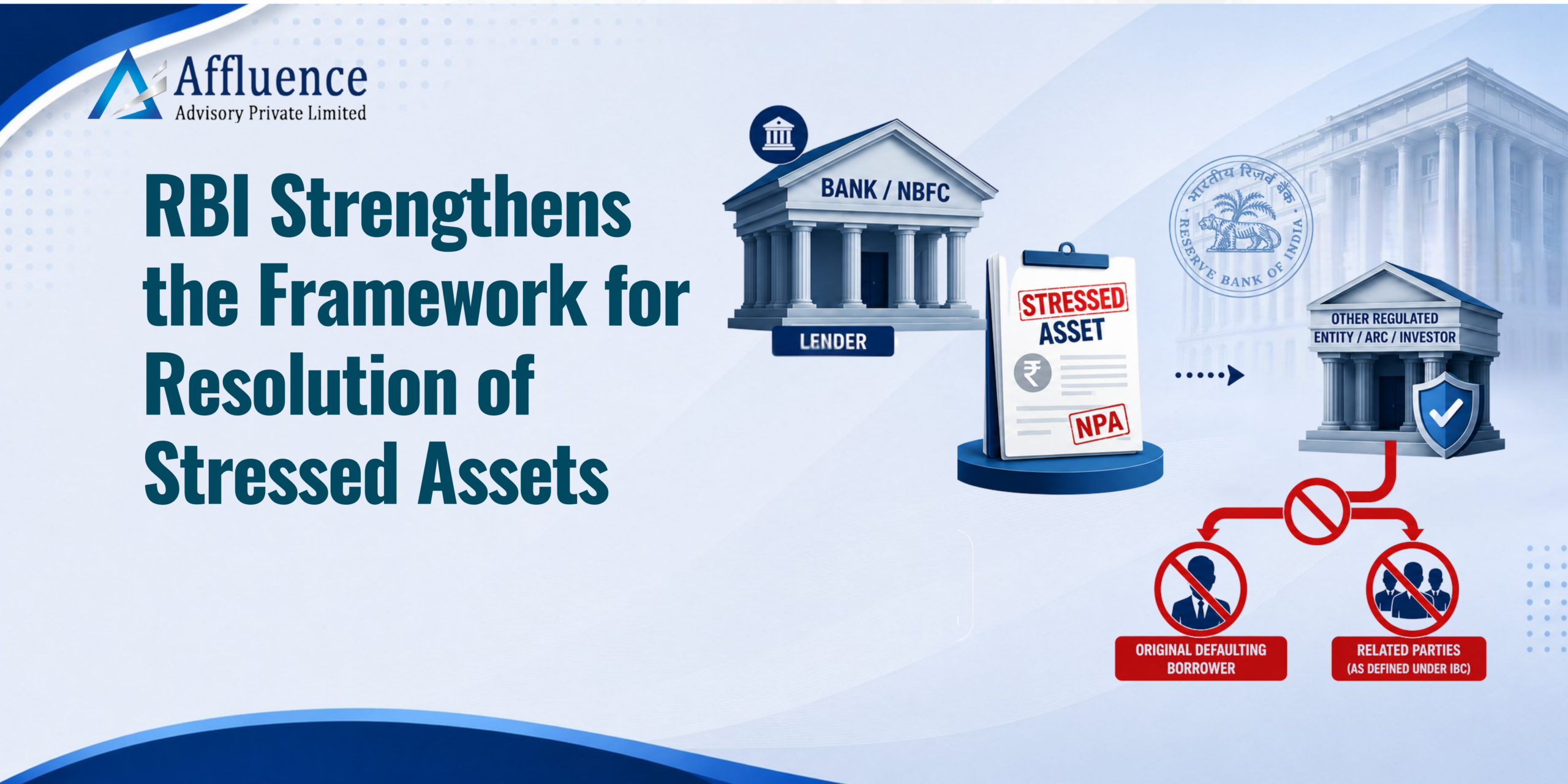
The NBFC – Resolution of Stressed Assets Amendment Directions, 2026, introduce a more structured pathway for dealing with impaired accounts. A significant highlight is the formalisation of the “Unregistered Type I NBFC” category.
- Exemption for Low-Risk Entities: Entities with an asset size below ₹1,000 crore, no public funds, and no customer interface are now eligible for deregistration. This move reduces the compliance burden on family offices and investment vehicles that operate purely on proprietary funds.
- Resolution Timelines: The amendment tightens the timelines for implementing Resolution Plans (RPs), ensuring that stressed assets are addressed before they deteriorate further, thereby protecting the NBFC’s capital adequacy.
2. Streamlining IRACP and Provisioning Norms
The amendments to Income Recognition, Asset Classification, and Provisioning focus on transparency and the integration of modern financial arrangements like Default Loss Guarantee (DLG).
- ECL and DLG Integration: For NBFCs following the IndAS framework, the new directions provide explicit clarity on factoring DLG into Expected Credit Loss (ECL) calculations. NBFCs are now required to recompute provisions upon every invocation of a guarantee, ensuring the financial statements reflect the real-time risk cover.
- Uniformity in Classification: The RBI has further aligned the “out-of-order” criteria and the definition of “overdue” across various NBFC layers, reducing regulatory arbitrage between banks and non-bank lenders.
3. Strengthening Responsible Business Conduct
With the rise of digital lending and third-party recovery agents, the NBFC – Responsible Business Conduct Amendment Directions place the onus of ethical behaviour squarely on the Board of Directors.
- Customer Protection: NBFCs must now ensure that Fair Practice Codes (FPC) are available in vernacular languages. Transparency in interest rate setting and “penal charges” (which must be clearly distinguished from “penal interest”) is now mandatory.
- Grievance Redressal: The directions mandate a multi-level grievance redressal mechanism where disputes must be heard by a functionary at least one level higher than the original decision-maker. This ensures a fair trial for borrower complaints regarding excessive interest or recovery harassment.
Conclusion
The April 29, 2026, amendments represent the RBI’s commitment to a proportionate regulatory regime. By deregulating low-risk investment entities while simultaneously tightening the screws on income recognition and customer conduct for systemic players, the RBI is fostering a more resilient and consumer-centric financial ecosystem. For NBFCs, the message is clear: growth must be accompanied by robust governance and ethical lending practices.
Disclaimer: This article provides general information existing at the time of preparation and we take no responsibility to update it with the subsequent changes in the law. The article is intended as a news update and Affluence Advisory neither assumes nor accepts any responsibility for any loss arising to any person acting or refraining from acting as a result of any material contained in this article. It is recommended that professional advice be taken based on specific facts and circumstances. This article does not substitute the need to refer to the original pronouncement.
CLICK HERE DOWNLOAD PDF