 +91 859 116 7727
  connect@affluence.net.in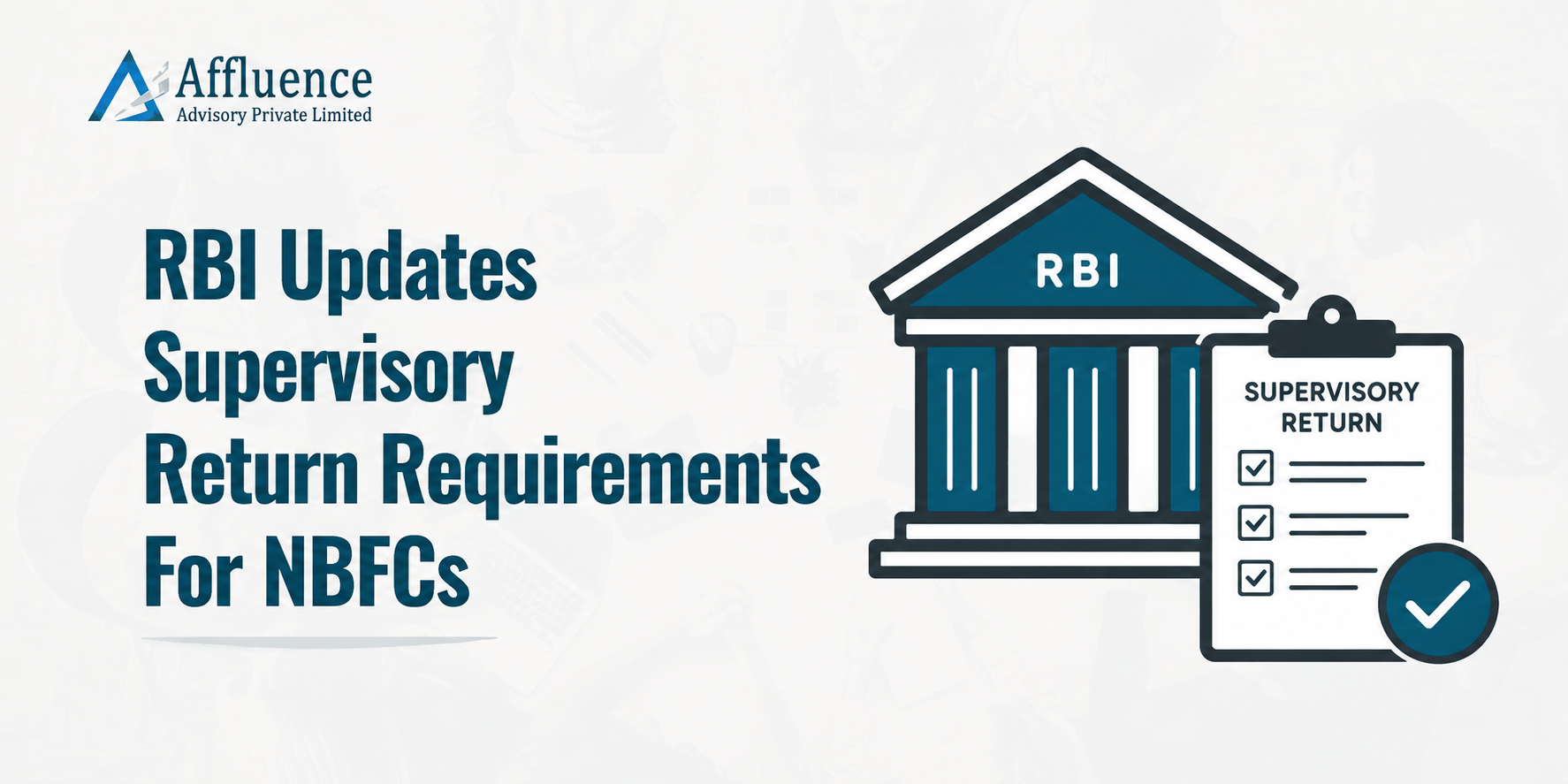
Rbi Updates Supervisory Return Requirements For NBFCs
The Reserve Bank of India (“RBI”), on July 31, 2026, issued the Reserve Bank of India (Non-Banking Financial Companies – Supervisory Returns) Directions, 2026 (“Directions”).
The Directions bring together the requirements relating to supervisory returns to be submitted by Non-Banking Financial Companies (“NBFCs”). They do not replace the entire reporting structure with a new system. Instead, they place the existing return requirements, filing conditions and reporting expectations within a single regulatory document.
The return applicable to an NBFC will continue to depend on its category, regulatory layer, asset size, deposit-taking status and business activities. Accordingly, the Directions should be read on a return-by-return basis rather than as a uniform reporting requirement applicable to all NBFCs.
Areas covered by the Directions
The Directions deal with various types of supervisory information, including:
- financial and prudential information;
- asset-liability management;
- large exposures;
- defaulted borrowers;
- statutory auditor certifications;
- fraud-related information;
- information applicable to specific categories of NBFCs; and
- reporting requirements applicable to Standalone Primary Dealers.
The relevant return may be periodic, event-based or required in response to a specific supervisory request. The Directions also set out the applicable reporting frequency, reference date, filing deadline and mode of submission.
Changes requiring attention
Although the Directions largely bring together existing requirements, some changes are relevant from a compliance and reporting perspective.
DNBS09 has been renamed
The return previously referred to as DNBS09 – CRILC Weekly – RDB Return is now described as DNBS09 – Return on Defaulted Borrowers.
The revised name provides a clearer indication of the information to be reported. NBFCs should update their internal compliance registers, reporting checklists and standard operating procedures to reflect the revised terminology.
Reporting by NBFCs in the Upper Layer
For NBFCs classified in the Upper Layer, the large-exposure reporting requirement now covers the NBFC’s 20 largest exposures, along with other exposures required to be reported under the applicable framework.
This change will require NBFC-ULs to review the data fields used for extracting exposure information and confirm that the reporting process captures the required population of exposures. The reporting logic should also be aligned with the NBFC’s internal exposure and concentration-risk monitoring process.
Changes in fraud-related return names
The names of certain fraud-related returns have also been revised. These include the changes from:
- FMR-I to FMR;
- FMR-III to FUA; and
- FMR-IV to FMR 4.
The revised names should be incorporated into regulatory calendars, escalation matrices and responsibility charts so that a change in nomenclature does not result in confusion regarding the applicable filing.
Online filing requirements
The Directions reinforce RBI’s move towards technology-based regulatory reporting. The Form A Certificate is included within the online filing framework, and returns required to be filed electronically must be submitted through the reporting system specified by RBI.
NBFCs should not treat the online filing requirement as merely a change in submission method. It may also require changes to user access, maker-checker controls, data validation, approval workflows and evidence-retention practices.
Filing by post or email
Where electronic filing is prescribed, submission by hand delivery, post, courier or email will generally not be treated as valid filing unless RBI permits or requires such an alternative method.
Accordingly, an NBFC should retain evidence of the electronic submission, including the filing date, acknowledgement, submitted data and any system-generated confirmation.
Reporting by Standalone Primary Dealers
The Directions also include supervisory reporting requirements applicable to Standalone Primary Dealers. Entities falling within this category should separately review the returns applicable to their business and ensure that the relevant requirements are included in their reporting calendar.
Practical steps for NBFCs
NBFCs should conduct a return-wise review of their existing regulatory reporting arrangements. The purpose of the review should be to identify what has changed for the particular NBFC, rather than to assume that every return or filing requirement has been modified.
The review should cover:
- whether each return is applicable to the NBFC;
- the revised name and description of each return;
- the relevant reporting frequency and reference date;
- the applicable filing deadline;
- the designated RBI portal or reporting platform;
- changes in the information required to be reported;
- the reporting process for NBFCs in the Upper Layer;
- the DNBS10 statutory auditor certification process;
- the online filing process for the Form A Certificate;
- fraud-reporting triggers and timelines;
- maker-checker and approval arrangements; and
- reconciliation of regulatory returns with books, systems and internal reports.
The NBFC should also identify the person responsible for preparing each return, the person responsible for review and approval, and the records that must be retained as evidence of compliance.
What this means for NBFCs
For most NBFCs, the Directions are likely to result in a review and alignment exercise rather than a complete overhaul of the reporting framework.
The immediate priority should be to update the regulatory return matrix and confirm that each applicable return is linked to the correct reporting frequency, timeline, portal and internal owner. NBFCs in the Upper Layer and entities subject to specific fraud, auditor-certification or SPD-related reporting requirements should undertake a more detailed assessment.
The practical message from the Directions is clear: NBFCs should treat supervisory reporting as a controlled internal process, supported by reliable data, defined ownership and documented review procedures—not merely as a periodic form-filing exercise.
Disclaimer: This article provides general information existing at the time of preparation and we take no responsibility to update it with the subsequent changes in the law. The article is intended as a news update and Affluence Advisory neither assumes nor accepts any responsibility for any loss arising to any person acting or refraining from acting as a result of any material contained in this article. It is recommended that professional advice be taken based on specific facts and circumstances. This article does not substitute the need to refer to the original pronouncement.