 +91 859 116 7727
  connect@affluence.net.in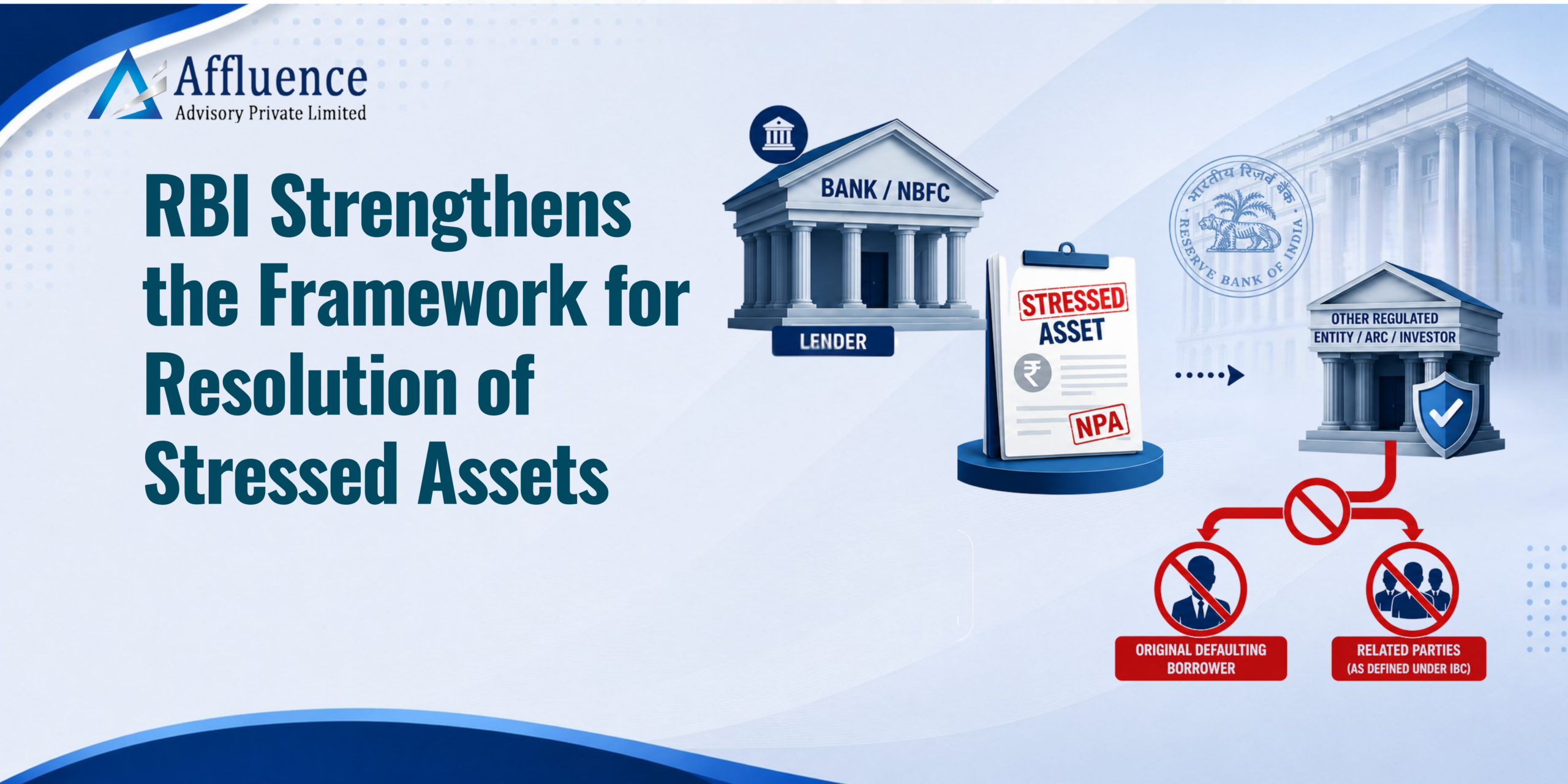
RBI Strengthens the Framework for Resolution of Stressed Assets
The Reserve Bank of India (RBI) has recently introduced an important reform in the framework governing the sale of stressed financial assets by banks and Non-Banking Financial Companies (NBFCs). Under the revised directions, lenders will no longer be permitted to sell acquired stressed assets back to the original defaulting borrower or any of its related parties. The new regulations are scheduled to become effective from October 1, 2026.
While the announcement may appear to be a technical regulatory change, its implications extend far beyond operational compliance. The measure reinforces credit discipline, reduces the possibility of regulatory arbitrage, and enhances the credibility of India’s stressed asset resolution ecosystem.
Understanding Stressed Assets
Before understanding the significance of the RBI’s latest move, it is important to understand what constitutes a stressed asset. A stressed asset refers to a loan where the borrower has either defaulted or is facing significant financial distress, thereby increasing the probability that the lender may not recover the outstanding dues. If repayment delays continue beyond the prescribed period, such loans are eventually classified as Non-Performing Assets (NPAs).
Illustrative Example
Consider a manufacturing company that borrows ₹100 crore from a bank to establish a new production facility. Due to weak demand and operational challenges, the company fails to repay its loan obligations. The account is classified as a stressed asset and eventually becomes an NPA.
The lender now has multiple recovery options:
- Restructure the loan.
- Initiate insolvency proceedings under the Insolvency and Bankruptcy Code (IBC).
- Enforce security under the SARFAESI Act.
- Sell the stressed asset to another financial institution, Asset Reconstruction Company (ARC), or eligible investor.
Historically, certain transactions created situations where the defaulting borrower, either directly or through related entities, could ultimately regain control over the same stressed asset at a discounted valuation. Such practices diluted the effectiveness of the recovery framework and weakened overall credit discipline.
What Has RBI Changed?
Under the revised directions, any stressed loan acquired by another regulated entity cannot subsequently be sold back to:
- the original defaulting borrower; or
- any related party of the borrower, as defined under the Insolvency and Bankruptcy Code (IBC).
Importantly, this restriction continues even if the asset is no longer classified as stressed at a later stage. The objective is straightforward—once a borrower has defaulted and the asset enters the resolution process, the borrower should not be able to regain the same asset through indirect arrangements or connected entities.
Why Was This Amendment Necessary?
The amendment primarily addresses concerns relating to moral hazard.
If borrowers believe they can intentionally default and subsequently reacquire the same asset at a substantially lower value, the incentive to honour debt obligations weakens considerably. For example:
Company A borrows ₹500 crore and the business defaults. The lender sells the stressed loan at a significant discount to any other regulated entity. A promoter-controlled or related entity purchases the asset at a lower valuation, thereby the promoter effectively regains the business while lenders absorb substantial losses.
Although every transaction may not have followed this pattern, the possibility itself undermined confidence in the resolution ecosystem. The RBI’s revised framework seeks to eliminate this loophole and ensure that defaults carry meaningful financial consequences.
Impact on Banks and NBFCs
The revised framework will require lenders to strengthen their due diligence during stressed asset transactions.
Banks and NBFCs will need to:
- conduct enhanced verification of buyers;
- identify beneficial ownership and related-party relationships;
- improve documentation and compliance procedures; and
- Maintain stronger governance throughout the sale process.
Although these measures may marginally increase transaction timelines, they are expected to improve the overall quality and transparency of distressed asset sales.
For NBFCs, particularly those active in retail lending and wholesale financing, stronger governance standards could enhance investor confidence and improve long-term access to capital.
Benefits for the Financial System
1. Better Credit Culture
The regulation reinforces an important principle: default should not become a strategy for acquiring assets at discounted prices. Borrowers will face greater consequences for wilful defaults, thereby encouraging timely repayment and responsible borrowing behaviour.
2. Improved Recovery Process
Genuine investors interested in operational turnaround will compete more fairly during stressed asset acquisitions. This should improve price discovery and enhance recovery values for lenders.
3. Stronger Investor Confidence
Global investors increasingly evaluate governance standards before investing in Indian financial institutions. A transparent stressed asset framework reduces regulatory uncertainty and strengthens confidence among institutional investors, private equity funds and foreign capital providers.
4. Reduced Systemic Risk
India’s banking sector has spent nearly a decade cleaning up legacy NPAs through regulatory reforms, stricter provisioning norms, the Insolvency and Bankruptcy Code, and improvements in credit underwriting. The latest amendment complements these initiatives by addressing a potential weakness in the post-default resolution process.
Challenges in Implementation
Determining whether a purchaser is a “related party” may not always be straightforward, particularly where ownership structures involve multiple holding companies, trusts or offshore entities. Accordingly, lenders will need robust governance mechanisms, detailed ownership verification, and continuous monitoring to ensure compliance with the revised framework.
Regulators may also need to issue additional operational clarifications as more complex transaction structures emerge.
Conclusion
The RBI’s latest amendment represents another step in strengthening India’s financial architecture. Rather than introducing a major structural overhaul, it closes an important gap that had the potential to undermine the integrity of stressed asset resolution.
From a broader perspective, the regulation promotes accountability, improves recovery discipline, and reinforces the principle that financial defaults should have genuine economic consequences. While banks and NBFCs may incur additional compliance responsibilities, the long-term benefits in the form of improved governance, stronger investor confidence and a healthier credit ecosystem are likely to outweigh the incremental costs.
As India’s financial sector continues to mature, reforms of this nature will play an important role in building a transparent, resilient and globally credible lending environment.
References
- Reserve Bank of India, Directions on Transfer of Stressed Assets, 2026.
- Economic Times, “RBI bars banks, NBFCs from selling acquired stressed assets back to defaulting borrowers or related parties.”
The Times of India, “Banks can’t sell back seized assets to defaulters: RBI.”
Disclaimer: This article provides general information existing at the time of preparation and we take no responsibility to update it with the subsequent changes in the law. The article is intended as a news update and Affluence Advisory neither assumes nor accepts any responsibility for any loss arising to any person acting or refraining from acting as a result of any material contained in this article. It is recommended that professional advice be taken based on specific facts and circumstances. This article does not substitute the need to refer to the original pronouncement.
CLICK HERE TO DOWNLOAD PDF