 +91 859 116 7727
  connect@affluence.net.in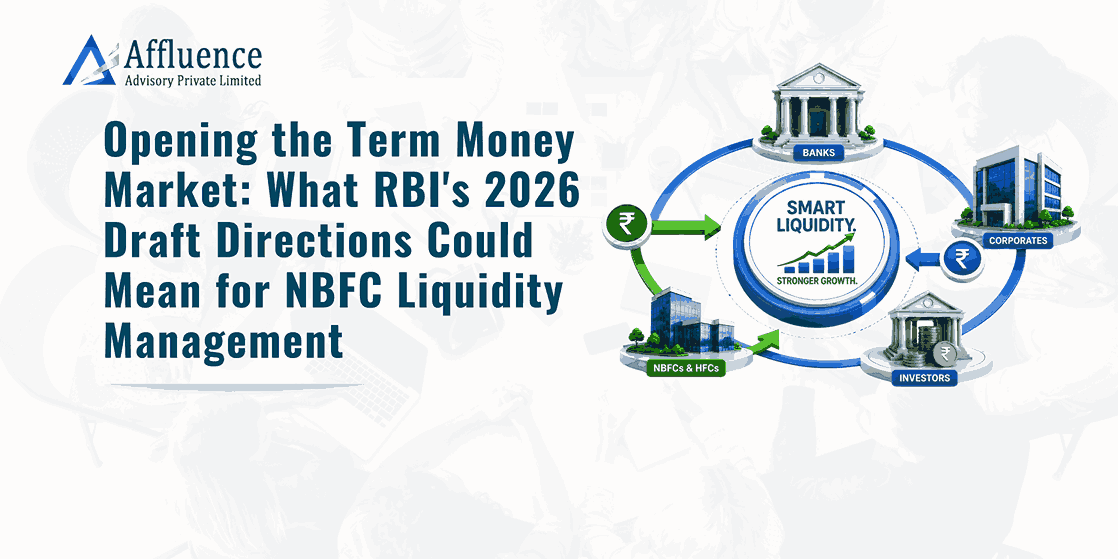
Opening the Term Money Market: What RBI’s 2026 Draft Directions Could Mean for NBFC Liquidity Management
RBI’s proposed framework could give eligible NBFCs a new institutional avenue to both raise and deploy short-term liquidity. But the significance of the proposal goes well beyond the headline borrowing ceiling of 200% of Net Owned Fund (“NOF“).
The Reserve Bank of India’s proposed Master Direction — Reserve Bank of India (Call, Notice and Term Money Markets) Directions, 2026 (“Draft Directions“) marks a potentially important development in India’s short-term funding architecture.
The most significant change for the non-banking financial sector is the proposed entry of Non-Banking Financial Companies (“NBFCs“), including Housing Finance Companies (“HFCs“), other than Base Layer NBFCs, into the Term Money Market as both borrowers and lenders. The Draft Directions also propose permitting All India Financial Institutions (“AIFIs“) to borrow and lend in this market, while companies would be permitted to participate as lenders.
At first glance, the proposal may appear to simply provide NBFCs with an additional avenue for borrowing. Its implications could, however, be wider.
If implemented substantially in its present form, the framework could broaden the Term Money Market from a market dominated by banks and Primary Dealers into a wider institutional liquidity ecosystem comprising banks, financial institutions, eligible NBFCs, HFCs and corporate treasuries.
For NBFCs, this could introduce another tool for liability diversification, liquidity management and deployment of temporary surplus funds. At the same time, participation would remain subject to prudential limits, Board-approved internal limits, counterparty appetite, exposure norms, market infrastructure and reporting requirements.
The proposal should therefore be viewed not simply as “another borrowing route”, but as a potential change in the way eligible NBFCs manage short-term liquidity.
The significance of the Draft Directions becomes clearer when viewed against the evolution of RBI’s money-market framework.
Under the Master Direction — Reserve Bank of India (Call, Notice and Term Money Markets) Directions, 2021, participation was restricted to specified banks, co-operative banks and Primary Dealers. Ordinary NBFCs and HFCs were not part of the eligible participant universe.
RBI subsequently recalibrated prudential limits for existing participants. In June 2021, the Term Money borrowing limit applicable to Primary Dealers was prescribed at 225% of NOF.
Another liberalisation followed in June 2023, when Scheduled Commercial Banks, excluding Small Finance Banks and Payment Banks, were permitted to determine their own Board-approved borrowing limits for Call and Notice Money, within RBI’s prudential framework for inter-bank liabilities.
The 2026 Draft goes a step further.
Instead of merely revising limits for existing participants, RBI proposes to expand the participant base itself.
The evolution may therefore broadly be viewed as:
- Prescribed prudential limits
- greater institution-level flexibility
- wider institutional participation
This is what makes the 2026 proposal structurally significant.
The unsecured money market is divided according to the tenor of borrowing or lending.
| Segment | Tenor | Proposed access for ordinary eligible NBFCs |
|---|---|---|
| Call Money | Overnight | No |
| Notice Money | More than overnight and up to 14 days | No |
| Term Money | More than 14 days and up to 1 year | Yes |
The Draft proposes a broader participant architecture for Term Money.
NBFCs, including HFCs, other than NBFCs classified in the Base Layer, would be permitted to participate both as borrowers and lenders.
AIFIs would similarly be permitted to participate both as borrowers and lenders.
Companies would be permitted to participate as lenders only in the Term Money Market.
Figure 1: Proposed segment-wise participation rights and selected prudential ceilings under RBI’s Draft Master Direction, 2026. The figures are not directly comparable across all participant categories and do not represent assured borrowing or lending capacity.
The illustration highlights an important distinction. The proposed 200% of NOF figure for eligible NBFCs and HFCs is an outstanding Term Money borrowing ceiling; it is not a guaranteed funding line, nor does it prescribe a universal lending limit. Actual market access will remain subject to Board-approved limits, prudential and exposure norms, counterparty appetite, pricing and market liquidity.
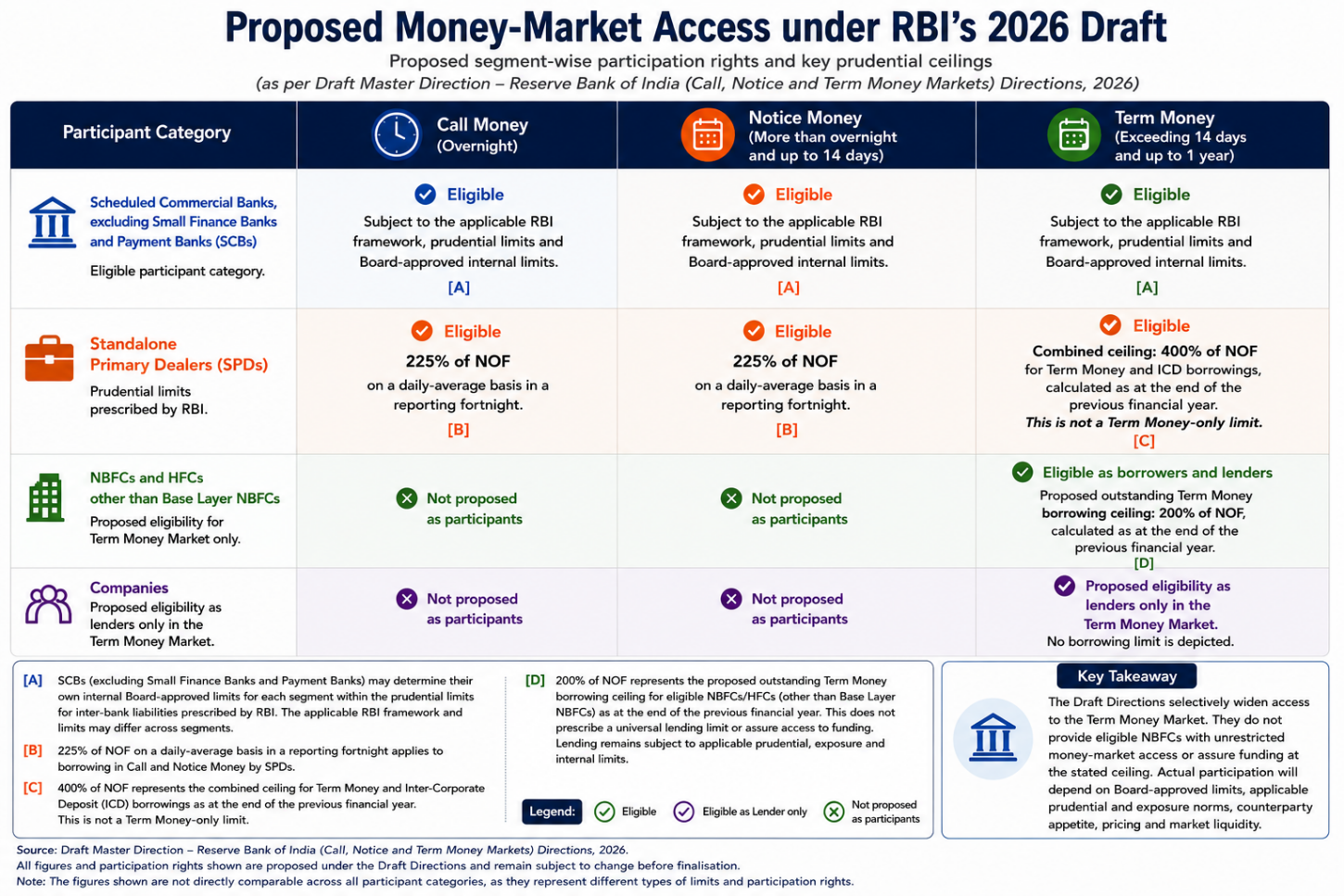
One of the most discussed features of the Draft Directions is the proposed ceiling on Term Money borrowing by eligible NBFCs and HFCs. Under the proposed framework, the outstanding borrowing of an eligible NBFC or HFC in the Term Money Market may not exceed 200% of its NOF, calculated as at the end of the previous financial year.
For illustration, where an eligible NBFC has NOF of ₹250 crore as at the end of the previous financial year, its outer proposed ceiling for outstanding Term Money borrowing would be:
₹250 crore × 200% = ₹500 crore
The ₹500 crore figure, however, should be understood only as the maximum regulatory ceiling under the Draft Directions. It does not represent an automatic borrowing entitlement, a committed credit facility or an assurance that the NBFC will be able to raise that amount in the market.
Actual borrowing capacity will be shaped by several layers beyond the regulatory ceiling. These include the NBFC’s Board-approved internal borrowing limit, the internal credit and exposure limits of prospective lenders, the NBFC’s credit profile, the proposed transaction tenor, prevailing market liquidity and the pricing acceptable to both parties.
The Draft Directions further require eligible participants to set their internal borrowing and lending limits with Board approval, within the applicable prudential framework, and to communicate those limits to the NDS-CALL system operator. The proposed 200% of NOF limit should therefore be viewed as a prudential outer boundary for Term Money borrowing, rather than a measure of assured funding availability.
- Implications for NBFC Treasuries
The proposed access to the Term Money Market may be particularly relevant from an NBFC treasury and asset-liability management perspective. NBFC funding structures generally comprise a mix of bank borrowings, non-convertible debentures, commercial paper, securitisation or direct-assignment transactions and other permissible institutional funding sources. Term Money could, if the Draft Directions are finalised substantially in their present form, add another unsecured instrument to this funding mix for tenors exceeding 14 days and up to one year.
The proposed facility may be relevant where an NBFC faces a short-to-medium-term liquidity requirement that does not warrant raising longer-tenor debt, but extends beyond the very short-term horizon. Illustratively, Term Money may be considered for:
- Temporary asset-liability management mismatches.
- Bridging funding requirements pending expected inflows or longer-term fund raising.
- Seasonal liquidity requirements.
- Timing differences between loan collections, disbursements and scheduled liability repayments.
- Tactical treasury requirements within approved liquidity-risk limits.
The potential value of the proposal lies in funding diversification and more transparent market-based price discovery. It may allow eligible NBFCs to assess and access an additional source of unsecured institutional liquidity, rather than relying only on conventional sources such as bank lines, commercial paper or debenture issuances.
However, access to Term Money should not automatically be equated with a reduction in borrowing cost. As an unsecured market, the price and availability of Term Money will depend on the NBFC’s credit profile, transaction tenor, prevailing liquidity conditions, lender concentration, counterparty appetite and the relative pricing of other funding sources. A highly rated NBFC may benefit from additional competitive pricing options; a lower-rated NBFC may face a higher risk premium or limited lender appetite.
Accordingly, the principal immediate benefit may be greater flexibility in liability management and improved market price discovery, rather than assured lower-cost funding. The actual benefit for a particular NBFC will depend on how Term Money pricing compares, on an all-in basis, with commercial paper, bank borrowings, debentures and other available funding alternatives
The proposal is equally important on the asset side of an NBFC treasury.
Eligible NBFCs would be permitted to participate in Term Money both as borrowers and lenders.
This means that an NBFC with temporary surplus liquidity could potentially deploy funds into the Term Money Market instead of viewing the framework solely as a funding source.
Conceptually:
Temporary liquidity deficit → Borrow Term Money
Temporary liquidity surplus → Lend Term Money
This two-way participation could make Term Money a liquidity-management instrument, rather than simply another borrowing product.
For larger NBFCs with active treasury functions, this distinction could become important.
One of the less discussed aspects of the Draft Directions is the proposed participation of companies as lenders in the Term Money Market. If operationalised, this may widen the pool of institutional liquidity available to eligible borrowers, including NBFCs and HFCs permitted to participate in the market.
Large corporates may hold temporary cash surpluses pending deployment towards working capital requirements, capital expenditure, acquisitions, dividend payments, debt servicing or other business purposes. Subject to the Companies Act, 2013, applicable regulatory requirements, their internal treasury policies and counterparty-risk parameters, the Term Money Market could provide an additional avenue for deployment of such short-term surplus funds.
The practical participation of corporate treasuries is likely to depend on the risk and governance framework adopted by each company. This may include minimum internal credit-rating thresholds for counterparties, approved counterparty lists, single-counterparty and group exposure limits, tenor restrictions, approval matrices, liquidity-buffer requirements and periodic monitoring of exposures.
The reference in the Draft Directions to Section 186 of the Companies Act, 2013 also merits attention. For companies participating as lenders, the applicability of Section 186 and the associated Rules would need to be assessed in the context of the relevant transaction, including the statutory limits, approval requirements and available exemptions. Corporate participation may therefore be driven not only by the availability of surplus funds, but also by the ability to establish an appropriate legal, treasury and credit-risk framework for unsecured lending.
Accordingly, the proposed entry of companies should be viewed as a potential source of additional liquidity, rather than an assurance that significant corporate funds will immediately become available in the Term Money Market. The extent of participation will ultimately depend on market pricing, credit appetite, risk governance and the development of reliable counterparty assessment practices.
- Operational and Prudential Guardrails
The Draft maintains an important regulatory principle.
Prudential limits for lending are to be determined by participants with Board approval. In the case of regulated entities, these limits must remain within RBI’s applicable exposure norms.
Further, lending by specified regulated participants to non-bank participants would remain subject to RBI guidelines applicable to loans and advances, except the guidelines relating to interest rates on advances.
Therefore:
Permission to participate in the Term Money Market does not mean exemption from credit, exposure or prudential requirements.
Counterparty assessment, concentration risk, internal credit limits and exposure monitoring will continue to remain central to treasury decision-making.
The existing Directions provide market timings of 9:00 AM to 5:00 PM on business days.
The Draft proposes extending market hours to 9:00 AM to 7:00 PM.
While this may appear to be a relatively operational change, a wider dealing window could provide greater flexibility to institutions managing liquidity positions and funding requirements during the course of a business day.
RBI’s Draft Directions are significant not merely because they propose a 200% of NOF ceiling for eligible NBFCs and HFCs. Their broader importance lies in the proposed expansion of the institutional unsecured money market to include a wider set of financial and corporate participants.
For eligible NBFCs, Term Money could provide an additional channel for managing short-term funding requirements and deploying temporary surplus liquidity. The proposal may support liability diversification, tenor matching and improved price discovery. However, lower funding cost is not guaranteed, and regulatory eligibility should not be confused with assured access to funds.
The practical outcome will depend on Board-approved limits, counterparty credit appetite, exposure norms, market liquidity, operational readiness and the willingness of institutions to transact on both sides of the market.
If sufficient market depth develops, the proposal could represent more than another funding option for NBFCs. It could mark a gradual integration of the non-banking financial sector into India’s broader institutional market for short-term liquidity.
Disclaimer
This article is based on the Draft Master Direction — Reserve Bank of India (Call, Notice and Term Money Markets) Directions, 2026 and the regulatory framework referred to herein. The Draft Directions are subject to change before finalisation. This article is intended for general informational and discussion purposes and should not be construed as legal, regulatory, investment or professional advice.
CLICK HERE TO DOWNLOAD PDF