 +91 859 116 7727
  connect@affluence.net.in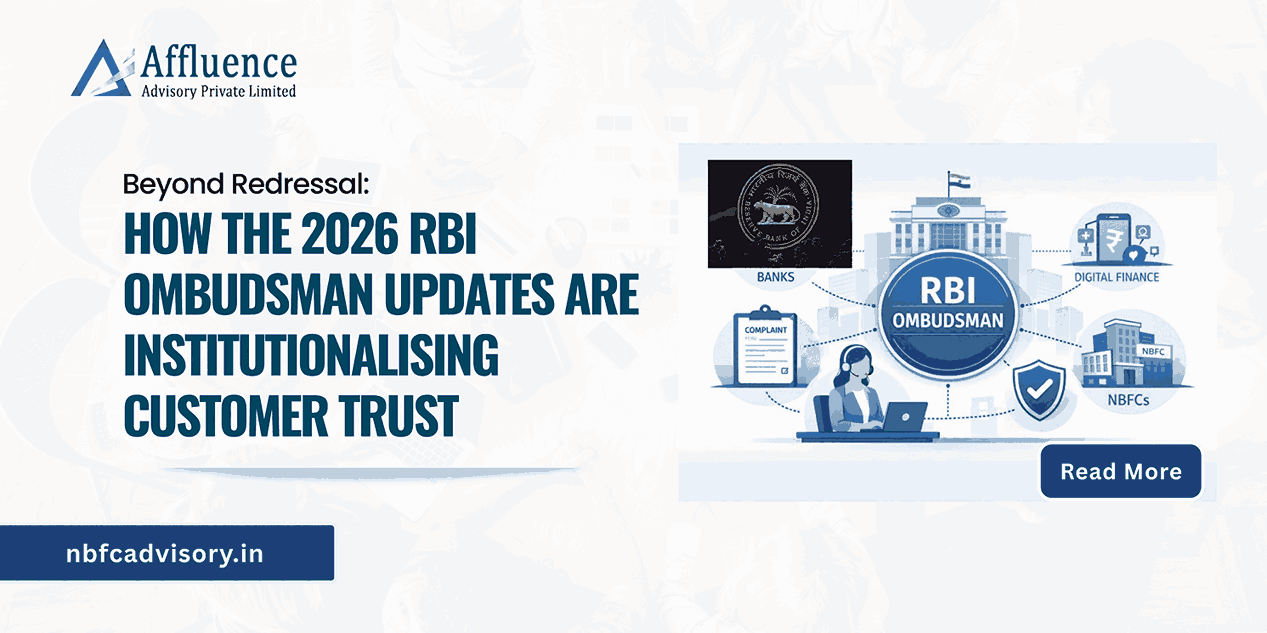
Beyond Redressal: How the 2026 RBI Ombudsman Updates are Institutionalising Customer Trust
The landscape of Indian financial services has undergone a seismic shift. In 2026, the Reserve Bank of India (RBI) moved beyond the traditional “firefighting” approach to consumer grievances. The latest updates to the Integrated Ombudsman Scheme (RB-IOS) and the Internal Ombudsman (IO) framework signify a transition from passive dispute resolution to a proactive regime of institutionalised trust.
For Non-Banking Financial Companies (NBFCs), these changes are no longer just “compliance checkboxes”; they are the new foundation of market credibility.
1. The Strategic Shift: From Redressal to Governance
For decades, the ombudsman was viewed as a “court of last resort.” If a customer was unhappy, they reached out, and a mediator intervened. However, the 2026 updates have flipped this script. The RBI now views the grievance machinery as a governance audit tool.
The core philosophy in 2026 is “Resolution by Design.” By integrating the ombudsman’s principles into the daily operations of NBFCs, the regulator is ensuring that trust is baked into the product lifecycle from the first digital loan click to the final repayment.
|
Feature |
Traditional Approach |
2026 Ombudsman Mandate |
|
Applicability |
Limited to Top-tier NBFCs |
Expanded to most Middle & Upper Layer NBFCs |
|
Reporting |
Periodic/Static Reports |
Real-time API-based data sharing via CMS 2.0 |
|
IO Authority |
Advisory / Recommendatory |
Mandatory "Concurrence" for all rejections |
|
Scope of Protection |
Transactional Errors |
Algorithmic Bias & Digital Lending Missteps |
2. The Internal Ombudsman (IO): The New Sentinel
One of the most significant updates in 2026 is the mandatory expansion of the Internal Ombudsman framework. Previously, only the largest NBFCs were required to appoint an IO. Today, the net has widened to include mid-sized entities that handle significant retail volumes.
The “Quality of Rejection” Rule
The most feared and effective change is the Mandatory Concurrence Rule. In the past, a junior officer could reject a customer’s complaint with a template response. In 2026, if an NBFC intends to reject a complaint (partially or fully), the file must be reviewed and signed off by the Internal Ombudsman.
This creates a high barrier to “lazy rejections.” The IO, who is an independent statutory appointee with no performance pressure from the lending side, acts as a filter. If the IO finds the rejection unfair, the NBFC must reconsider. This ensures that only legitimate, legally sound rejections reach the customer, drastically reducing the burden on the RBI’s Integrated Ombudsman.
3. Digital Lending and the “Algorithmic Fairness” Mandate
With the explosion of fintech-led NBFCs, the 2026 updates have introduced a specific chapter on Digital Underwriting and Automation. The Ombudsman now has the authority to investigate “algorithmic bias.”
If a customer claims they were unfairly denied a loan due to a flawed AI model or a biased data point (such as location or demographic-based “redlining”), the Ombudsman can demand an “Explainability Report” from the NBFC.
Protected Digital Rights in 2026:
- Transparency in Interest Resets: Floating rate transitions must be communicated via the Ombudsman-approved notification standard.
- LSP Accountability: NBFCs are now 100% liable for the conduct of their Lending Service Providers (LSPs). If a recovery agent from a third-party app harasses a borrower, the Ombudsman holds the NBFC’s board accountable.
4. The Tech-Backbone: CMS 2.0 and API Integration
The “Integrated” in the Integrated Ombudsman Scheme has reached its peak in 2026 through the Complaint Management System (CMS) 2.0.
The RBI has mandated that Upper Layer NBFCs integrate their internal grievance portals directly with the RBI’s central server via APIs. This means:
- Zero Latency: The moment a complaint is filed with the NBFC, the RBI’s “Big Data” engine sees it.
- Heatmap Analysis: The RBI can now identify “Grievance Hotspots”—if 500 people in a single week complain about the same gold loan app, the regulator can trigger a spot audit before the issue becomes a systemic crisis.
- Automatic Escalation: If a complaint is not resolved within the 30-day window, the system automatically elevates it to the Integrated Ombudsman without the customer needing to follow up.
5. Strengthening the “Independent” in Independent Ombudsman
A common criticism in the past was that Internal Ombudsmen were often “captured” by the management. The 2026 guidelines have fortified their independence:
- Fixed Tenure: A mandatory 3 to 5-year tenure that cannot be shortened without RBI approval.
- Reporting Lines: The IO reports directly to the Board’s Consumer Protection Committee, bypassing the CEO and the Credit Head.
- Removal Protections: An IO cannot be removed for giving “pro-customer” decisions; any removal requires a formal “No Objection Certificate” from the RBI.
6. Impact on Customer Trust and Market Value
The result of these updates is a tangible increase in consumer confidence. When customers know that a high-ranking, independent official (the IO) must review their rejected claim, their trust in the brand increases.
For investors, a “Clean Ombudsman Report” has become a key ESG metric. NBFCs with low escalation rates to the RBI Ombudsman are seeing better credit ratings and lower costs of capital. Trust is no longer an abstract concept; in 2026, it is a quantifiable financial asset.
Conclusion: The New Social Contract
The 2026 updates to the RBI Ombudsman framework signify the birth of a new social contract between Indian lenders and borrowers. By institutionalising trust through mandatory internal oversight and real-time digital transparency, the RBI has ensured that the growth of India’s NBFC sector is both sustainable and ethical.
For the modern NBFC, the message is clear: Trust is the new capital. Those who invest in robust grievance machinery today will be the market leaders of tomorrow, while those who view the Ombudsman as an adversary will find themselves increasingly sidelined by both the regulator and the market.
Disclaimer: This article provides general information existing at the time of preparation and we take no responsibility to update it with the subsequent changes in the law. The article is intended as a news update and Affluence Advisory neither assumes nor accepts any responsibility for any loss arising to any person acting or refraining from acting as a result of any material contained in this article. It is recommended that professional advice be taken based on specific facts and circumstances. This article does not substitute the need to refer to the original pronouncement.
CLICK HERE DOWNLOAD PDF